The Problems That Hold Businesses Back Aren't Industry Problems. They're Human Ones.
March & April: What I Built, Who I Served, and Why It Matters
Some seasons in business feel scattered. This wasn't one of them.
March and April brought three very different engagements — a multi-day leadership conference for a hotel management company, a workshop for the Working Moms of San Antonio, and a panel for NAWBO San Antonio's Brunch & Learn. Different industries, different audiences, different deliverables. But the same thread ran through all of it: the problems that hold people back aren't industry problems. They're human problems. And the work that actually moves the needle isn't inspiration — it's structure that sticks.
Starting at the Top: A GM Leadership Conference
The most meaningful engagement of the spring started with a decision I don't see often enough: if we want to change the culture across our properties, we have to start with the people leading them.
A multi-brand hotel management company came in with data — a company-wide engagement survey across every associate, every level — and the courage to be honest about what it showed. Not enough feedback. Communication that wasn't landing. Recognition that happened sometimes, inconsistently, and usually too quietly. If those sound familiar, they should. They're not hospitality problems. They're the most common leadership failures across every industry, in organizations of every size. The names change. The scores don't.
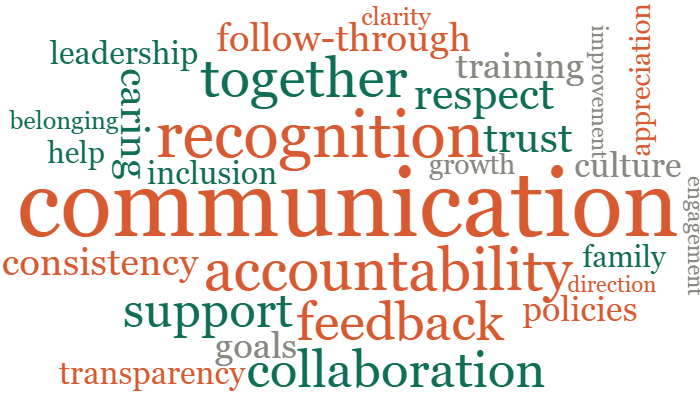
What was different here was the willingness to actually do something about it.
Over several weeks, I worked with the team to designed and then facilitated a multi-day GM Leadership Conference built around one foundational belief: trust is the soil — everything else is what you plant in it. Before we could talk about behaviors, we had to do the harder work of building a culture where those behaviors could actually take root. That meant naming what erodes trust, what rebuilds it, and what it costs when leaders skip that step.
From that foundation, we worked through three leadership behaviors — feedback, communication, and recognition — not as HR talking points, but as daily operational practices. Every conversation was anchored in what their people actually need to feel: understood, like they belong, cared for, in control of something, and like they're growing. The why behind what a great leader does every single shift.
The conference included a peer roundtable where leaders brought real situations from their own properties and got honest input from colleagues who understand the work — not advice, not judgment, just real questions from people who get it. A live expert panel, moderated around questions submitted in advance, kept everything grounded in what they were actually wrestling with. Every participant left with a full working document — not a souvenir, but something to return to.
What I'm most proud of is that this was never designed as a one-time event. The shared language, the common frameworks, the peer connections built in that room — that was always meant to be the beginning of something larger. The work continues.
Revenue Is Addition. Loyalty Is Multiplication.
I've been in rooms with a lot of smart business owners. Almost every one of them is working harder than they need to — not because they're doing the wrong things, but because they're missing one piece of the equation.
This spring I brought a workshop to the Working Moms of San Antonio that I've been developing for a while. The title was Revenue Is Addition. Loyalty Is Multiplication. And the room response told me everything I needed to know about whether this content has legs.
Here's the short version: Revenue is math. Rate times volume. You can add to it, subtract from it, and calculate it. Most business owners have a handle on the addition side — even if they're undercharging.
But loyalty is a multiplier. One loyal client generates repeat revenue, referrals, and a reputation you didn't have to pay for. Ten loyal clients doing that consistently is a pipeline that runs without you constantly feeding it. And here's the part that seemed to hit hardest: you cannot buy loyalty with a lower price. You build it with connection.
We worked through the Five Pillars of Human Connection — the drivers that make clients stay, come back, and tell their people about you. We practiced hard conversations using a framework called LEARN. We mapped referral ecosystems and each person left with one relationship they were going to activate in the next 30 days.
It was a good morning. And honestly, this content wants to be bigger. The framework is solid. The exercises work. The questions this workshop surfaces are ones solopreneurs and small business owners are carrying around every day without a clear answer. This isn't the last time you'll see this material.
Pricing Without Apology
The NAWBO San Antonio Brunch & Learn brought together a panel focused on something I see constantly: pricing that's driven more by fear than by strategy.
There was rich conversation about our relationship with money and how past experiences shape the way we price today. That matters. But where I leaned in was what happens next — because awareness is helpful, and it doesn't change your business unless it connects to something practical.
I focused on three things.
Sustainability over likeability. A lot of business owners are pricing to be easy to say yes to. The problem is that version of pricing usually isn't sustainable. If you're feeling resentful, overbooked, or stretched thin, your pricing is telling you something.
You're not pricing the hour — you're pricing the business. We walked through hidden labor: emails, prep, admin, follow-up — the work that never shows up in a quote but absolutely impacts your time and energy. If it's not accounted for, you're working for free somewhere.
Confidence backed by math. We used a simple framework to understand what you actually keep after a job, not just what you charge. Because if you don't know that number, confidence will always feel a little shaky. When you do know it, decisions get a lot clearer.
One of my favorite moments was watching people work through the Sustainability Check — a simple set of questions that forces honesty: Can I deliver at this price without resentment? Can I rest and still do great work? Am I overbooked? You could see the lightbulbs going off.
We also talked about something I say often: objections aren't rejection — they're curiosity. When someone pushes back on price, they're usually asking for clarity, not saying no. And if you understand your numbers and your scope, you can respond without folding.
Pricing gets easier when it's not emotional guesswork. When it's structured. When it's tested. When it actually supports the business you're trying to build.
The Thread
Three engagements. Three different rooms. One consistent truth underneath all of it.
The problems that hold teams and businesses back aren't unique to their industry. They're human. Leaders who don't give feedback, business owners who underprice, entrepreneurs who mistake revenue for loyalty — these aren't isolated failures. They're patterns. And patterns can be interrupted with the right frameworks, the right conversations, and work that's designed to last beyond the room it happened in.
That's what I build. That's what this spring was about.
If any of this is resonating — if you're a leader trying to shift your culture, a business owner wrestling with pricing or client retention, or an organization looking for a workshop or keynote that actually does something — I'd love to talk.
Reach out. This is exactly the work I do.
